

2025 Market Update
What You Need to Know
Market Commentary - December 2025
Markets welcomed the end of the US government shutdown in November, though the full economic impact remains unclear. At 43 days, this was the longest shutdown in history, surpassing the previous 35-day record during Trump’s first term. The disruption affected hundreds of thousands of federal employees and delayed the collection of critical economic data, including inflation and unemployment figures. The funding bill however only extends through to the end of January, leaving the risk of renewed uncertainty early next year.
Expectations for Federal Reserve easing built over November following dovish comments from several Fed officials. Vice Chair Williams highlighted rising labour market risks and easing inflation pressures, describing rates as “mildly restrictive”, a stance seen as aligned with Chair Powell. Market pricing now reflects a high probability of a December rate cut. US data releases were generally soft, with ADP payrolls declining, consumer confidence weakening, and retail sales losing momentum heading into the fourth quarter.
The Reserve Bank of New Zealand delivered a hawkish 25bp cut to 2.25%, signalling the likely end of its easing cycle. Updated forecasts imply just a 20% probability of another cut early next year, and one MPC member voted to hold rates steady. Markets reacted sharply, with two-year yields up nearly 30bp and the NZ dollar appreciating 2% over the week. Subsequent data reinforced this stance: Q3 retail sales rose 1.9% versus 0.6% expected, business confidence surged to an 11-year high, and consumer confidence improved notably, supporting the view that an economic recovery is underway.
In Australia, an unexpected rise in core inflation in October has diminished prospects for near-term RBA cuts. Trimmed mean CPI increased to 3.3% year-on-year versus expectations for a decline to 3.0%. With limited evidence of spare capacity, markets now anticipate an extended period of unchanged rates at 3.6%, with only a marginal chance of hikes late next year.
Global equities experienced a notable rotation in November, with defensive sectors such as healthcare and consumer staples outperforming, reversing the trend observed so far this year. Despite a strong third-quarter earnings season, where 81% of S&P 500 companies beat consensus estimates, returns over the month were slightly negative. Technology was the weakest sector, reflecting concerns over inflated valuations, even as EPS growth forecasts for the Magnificent Seven surged to over 22% for 2026.
A notable example of circular finance is Nvidia’s investment in CoreWeave, a cloud infrastructure provider specialising in graphics processing unit (GPU) based computing to perform complex calculations. CoreWeave, in turn, purchases large quantities of Nvidia’s computer chips to support AI workloads, creating a mutually beneficial, albeit potentially risky, financial loop.
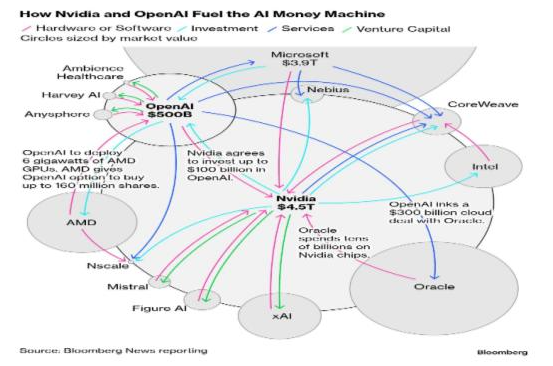
Despite concerns about potential overinvestment, many experts contend that current AI spending is laying the groundwork for transformative innovation—much like the internet’s rise from telecommunications overcapacity. Importantly, today’s AI development is based on genuine technological advancements, including breakthroughs in machine learning, scalable data infrastructures, and rapid enterprise adoption. These factors suggest that the long-term benefits could justify the scale of current investment.
Are we in an AI bubble? For now, the market signals both optimism and caution.
International Equities
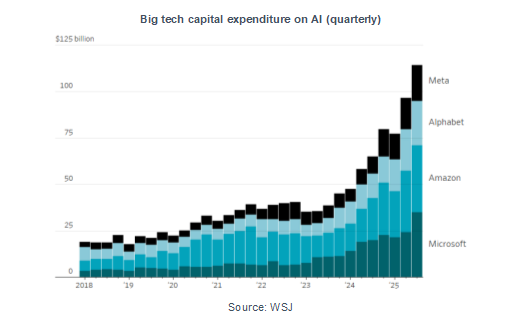
Given the comments above on the AI boom and significant investment by the US technology companies, there was a focus on their earnings updates. Among these companies, earnings results varied. Amazon and Alphabet delivered strong performances, with Amazon’s share price rising sharply and Alphabet also posting gains. In contrast, Meta and Microsoft experienced more muted market reactions. Meta’s shares declined, possibly reflecting uncertainty about its future growth prospects.
Microsoft, Alphabet, Meta, and Amazon collectively spent approximately $100 billion on AI capital expenditure in the third quarter alone, with forecasts suggesting AI spending in 2025 could exceed $400 billion among these companies.
Japan’s sharemarket surged by 16.7% in October due to optimism over new Prime Minister Takaichi’s pro-growth policies, a rally in technology companies, and a weaker yen that boosted exporters. European sharemarkets performed solidly supported by strong corporate earnings and expectations of increased in government spending.
Australasian Equities
New Zealand’s sharemarket rose 1.9% in October, boosted by lower short-term interest rates and positive trading updates from selected companies.
While updates from Fletcher Building and Air New Zealand highlighted ongoing challenges in the domestic economy, other companies, while acknowledging headwinds, took a more pragmatic stance, emphasising operational resilience, cost control, and positioning for recovery.
In company specific updates, Freightways reported strong first-quarter results, with revenue increasing by 8.6% and net profit rising 22.5%. Infratil increased its stake in Contact Energy, reinforcing its strategy to scale core assets. Precinct Properties successfully raised NZ$325 million of additional equity in the month. This weighed on the sector’s performance, as investors sold other listed property securities to participate in the capital raise, amid concerns other companies within the sector may follow suit.
The Australian sharemarket rose by 0.4%, trailing behind global markets. This modest performance was primarily attributed to higher than expected inflation, which dampened investors sentiment and reduced confidence in near-term interest rate cuts.
Performance across sectors was mixed, but resource and energy companies stood out. A major factor was a new agreement between Australia and the United States to invest $8.5 billion in rare earth mining projects. This boosted shares in Pilbara Minerals, which rose by 31%, and Rio Tinto, which gained 8.9%. Additionally, the United States imposed sanctions on Russia’s largest oil producers, causing oil prices to rebound from a five-month low. As a result, energy company Woodside saw its share price increase by 7.7% in October.
Fixed income and cash markets
The Bloomberg Global Aggregate Bond Index (New Zealand dollar hedged) increased by 0.7%, supported by mild global inflation outcomes and interest rate cuts by the US Federal Reserve (Fed). Global bond yields declined amid concerns over slowing economic growth, particularly following reports of rising bad loans at regional US banks. By the end of the month, further updates suggested these bad loans were likely isolated incidents rather than a systematic issue. Nevertheless, these events underscore fragility and potential vulnerability within global credit markets currently.
In October, the US Federal Reserve (Fed) reduced interest rates by 25 basis points, setting the target range at 3.75–4.00%. The decision reflected internal division within the Fed, with one member favouring a larger cut and another preferring no change. Fed chair Jerome Powell adopted a cautious stance, noting that a further reduction in December is “not a foregone conclusion.”
The Bank of Canada cut rates to 2.25%, while the Bank of Japan (BOJ) and European Central Bank held rates steady. While the BOJ is expected to raise rates in December, most of the other major central banks appear to be approaching the end of their interest rate cutting cycles.
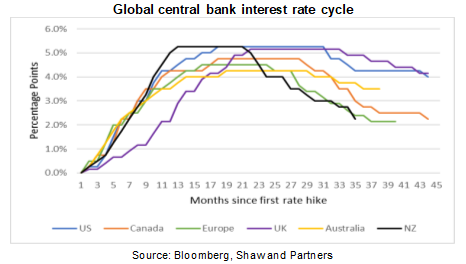
New Zealand’s fixed income market rose by 0.8% in October, supported by a larger than expected rate cut by the Reserve Bank of New Zealand (RBNZ) and declining global interest rates.
In a move that exceeded market expectations, the RBNZ cut the official cash rate by 50 basis points to 2.5%. The decision was driven by risk management considerations amid sluggish economic growth, including a contraction in second-quarter economic activity.
New Zealand’s inflation rose by 1.0% in the third quarter, bringing annual inflation to 3.0%, which is at the top end of the RBNZ’s target range. Inflation in New Zealand’s is expected to decline toward the mid-point of the target range by June 2026.
Conclusion
The growth in AI is expected to remain a key driver of markets into 2026, despite rising concerns about sustainability and high valuations. While some signs of speculative behaviour are present, ongoing progress in technology and increasing business adoption suggest long-term potential. Given current valuations, a brief period of sharemarket weakness would not be unexpected.
Low global short-term interest rates, increased government spending, and strong company earnings may continue to support global sharemarkets. However, caution is advised due to global economic uncertainty, the ongoing US government shutdown, and a divided Federal Reserve, which may disappoint investors regarding the timing and size of future interest rate cuts.
In this environment, we favour domestic investments. The financial markets in New Zealand and Australia are well-positioned compared to global peers and are likely to benefit from low short-term interest rates. However, returns from cash-based investments will continue to decline given the reduction in interest rates already undertaken by the RBNZ.
We continue to encourage investors to focus on their longer-term goals, remain patient during short-term market fluctuations, and maintain a portfolio aligned with their objectives and risk tolerance.